
by Li-Lan Hsiang Weiss, Licensed acupuncturist in North Carolina, USA
Five Elements Theory is a Chinese philosophy used to describe interactions and relationships between things. The Five Elements — Wood, Fire, Earth, Metal, and Water — are representations in nature that have been observed over time to help humans explain and understand the interactions of phenomenon, situations, and human interactions.
Chinese: 五行 Wǔ Xing /woo sshing/ ‘Five Actions’ or Five Paths. I prefer to refer to them as the Five Paths, as that is more representative of how the associations can be used: as paths of guidance. For Ba Zi terminology, let’s use the common translation of Elements.
Its History: Five Elements Theory first appeared during the Spring and Autumn Period (770–476 BC). It became widespread: mostly used in Chinese medicine, philosophy, feng-shui, life consultations, and martial arts.
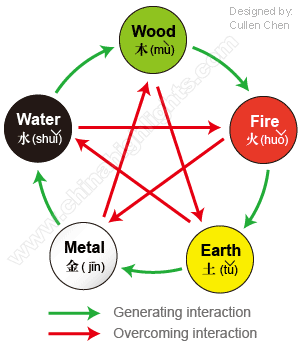
The five generating interactions are fueling, forming, containing, carrying, and feeding:
- Wood fuels fire.
- Fire forms earth (volcanoes, ash).
- Earth consolidates into metal.
- Metal carries water (buckets, pipes, minerals).
- Water feeds wood (trees, plants).
Overcoming Interactions (red arrows on the above chart)
The overcoming interactions of the five elements are opposing sides, like a team game. They are also called Grandparent and Grandchild relationship.
The five overcoming interactions are melting, penetrating, separating, absorbing, and quenching:
- Fire melts metal
- Metal penetrates wood (chopping, sawing, drilling, nailing, screwing).
- Wood separates earth (tree roots breaking up soil/rock).
- Earth absorbs water.
- Water quenches fire.
Ba Zi
Is an astrological system that helps bring to light one’s Life Potential by analyzing the blueprint of your personal birth data. Ba Zi means “eight characters” in Mandarin Chinese, of the four pillars there are two main characteristics each: the heavenly stem, and one of the 12 zodiac animals; thus eight characters.
The 4 Pillars are composed of the year of birth, month, day, and hour. Most people know their year animal, a more nuanced detail is the Element of that birth year, as well as whether it has a Yin- or Yang+ pair. It can be used for insight to help with making more discerning decisions. Each year alternates between yin and yang, so 2025 was a Yin Wood Snake year, and 2026 is a Yang Fire Horse Year. You can notice that each year moves along the generating cycle of the elements, as well as the order of the zodiac animals.
You can print out your personal BaZi birth chart HERE. It is Marlyna Los Consulting website, she has been offering free yearly Chinese New Year forecasts for Healthy Seminars, a popular online learning community for acupuncturists in North America. Other Ba Zi teachers and readers are Joey Yap and Allen Teo from Singapore. Below is the general extent of my understanding of Ba Zi, it is miniscule compared to what a professional reader and teacher can provide.
How to start interpreting your Ba Zi Chart:
With the basic chart, you will see a Year column, Month column, Day column, Hour column. Horizontally from top to bottom there are three rows: Heavenly Stem first, Animal next, Hidden Stem at the bottom.
Year column refers to: first impressions, general outlook, community, social circles
Month column refers to: career or boss, performance, parents, older siblings, business connections
Day column refers to: yourself, inner feelings, partner, intimate relationships
Hour column refers to: dreams, children, inner feelings, younger siblings, investments, assets
The place to start is to use your Day column’s Heavenly Stem, this is your Daymaster. There are 10 Daymaster types ( 5 Elements: Fire, Wood, Water, Metal. Earth x2 for Yin and Yang). The Daymaster refers to yourself, so it is the focal point around which all relationships of the Ba Zi chart revolve around.
5 Element Interactions
Once you know your Daymaster, you can read up on your Daymaster on various websites. Use these descriptions as characteristics, they may or may not apply to you. I find it more interesting to reflect on the natural element itself and see how it applies to you. For example: If Yang Wood is sturdy and slow growing like an oak tree, do you see characteristics of that in yourself, or maybe it is pointing towards qualities useful to embody and grow into? If Yin Earth is the soil that lines the banks of a river or the compost that takes in various substances, can you relate to qualities of providing flexible boundaries or taking time to “compost” information into something richer?
Next, find your Daymaster in the Five Element wheel and make note what Element is before and after and which is the Grandparent and Grandchild elements.
In Ba Zi terminology, the Element prior to the Daymaster is one’s Resource/Parent Element, the Element after is one’s Output/Child Element, two Elements prior (Grandparent) is the Power/Influencing Element, two Elements after (Grandchild) is one’s Wealth Element.
Each Element has a yin and yang archetype, called the 10 Gods. These are the names of the 10 Gods:
Direct Resource/ The Analyzer: Parent Element, opposite polarity as your Daymaster. Represents certifications, credentials, publicly visible resources (house, cars, practical assets)
Indirect Resource/ The Philosopher: Parent Element, same polarity as your Daymaster. Represents spiritual support, intangible assets, wisdom teachings, emotional strengths
Hurting Officer/The Performer: Output/Child Element, opposite polarity as your Daymaster. Represents creative risk takers, upsets the status quote, innovators, thinking/talking out loud, appears extroverted.
Eating God/The Artist: Output/Child Element, same polarity as your Daymaster. Represents the dreamer artist, introverted, learning through imagination.
Direct Officer/ The Diplomat: Grandparent/Power/Influencing Element, opposite polarity as your Daymaster. Represents consistency, boundaries, linear planning, mentoring.
Seven Killings/ The Warrior: Grandparent/Power/Influencing Element, same polarity as your Daymaster. Represents aggressive assertiveness, unpredictability, diligence.
Direct Wealth/ The Director: Grandchild/Wealth Element, opposite polarity as your Daymaster. Represents risk averse, stability, predictable wealth.
Indirect Wealth/ The Pioneer: Grandchild/Wealth Element, same polarity as your Daymaster. Represents opportunistic, risk taking, inconsistent/passive wealth.
Rob Wealth/ The Leader: Same companion Element as your Daymaster, opposite polarity. Represents community, collaborators, competitors, outer circles, acquaintances.
Friend: Same Element, same polarity as your Daymaster.
Write out which Element and polarity correspond to each of the 10 Gods in relationship to your Daymaster, and you’ll be able to start understanding parts of your Ba Zi chart that list the 10 Gods (they are listed with their initials).
In this updated Ba Zi blog post, we are going into the Year of the Yang Fire Horse, so what is Yang Fire in relationship to your Daymaster? Is it a Parent, Child, Grandparent, Grandchild or Same/Companion Element? And which 10 Gods is it in relationship to your Daymaster? This will then give you some insight into how the general energy of this year will affect your Daymaster. You can also look at how this year then relates to your Year/Public outlook, your Month/Career, and your Hour/children.
These may be are useful to know when understanding Chinese Astrology and your personal Ba Zi chart, particularly the Virtues and Representations of each Element.
Astrology Associations
| Characteristic | Wood | Fire | Earth | Metal | Water |
|---|---|---|---|---|---|
| Planets | Venus | Jupiter | Mercury | Mars | Saturn |
| Heavenly Creatures | Azure Dragon(青龙) | Vermilion Bird (朱雀) | Yellow Dragon (黄龙) | White Tiger (白虎) | Black Tortoise (玄武) |
| Heavenly Stems | 1st (Jia 甲), 2nd (Yi 乙) | 3rd (Bing 丙), 4th (Ding丁) | 5th (Wu 戊), 6th (Ji 己) | 7th (Geng 庚), 8th (Xin 辛) | 9th (Ren 壬), 10th (Gui 癸) |
| Virtue | Benevolence | Propriety | Fidelity/ Honesty | Righteousness | Wisdom |
| Represents | Creativity, luxuriance, blooming, and flourishing | Enthusiasm and passion | Nurturing, stability, and security | Ambition, determination, progress, and persistence | Aptitude, brightness, agile mind, and mental strength |
Have fun understanding your Ba Zi chart! Hope this article has been useful.
For more introductory information on the the Chinese Five Elements and how they can be applied for oneself, check out our posts Chinese Five Element Personality Types, Chinese Five Element & our Senses, Intro to the Chinese Five Elements & its associations
Our blog posts are categorized on the right side widget under various categories, check out the Chinese Five Elements and Self Care for ways to use each particular Element in your life. For experiencing the Five Elements through music, Qi Gong, acupressure, and meditations, check out Tones for your Bones workshops.